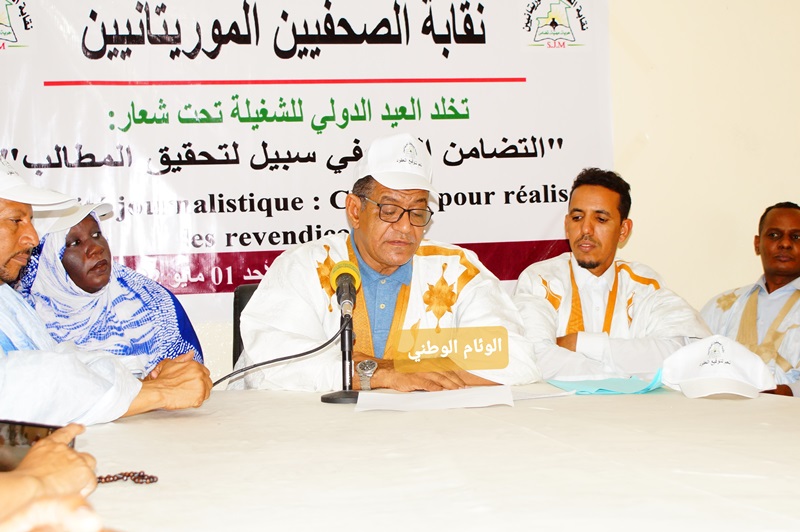
The Mauritanian Journalists’ Union held a ceremony at its headquarters to mark International Workers’ Day under the theme “Journalistic solidarity is the path to achieving our demands”.
The event was attended by Union members and a large gathering from the electronic press, national radio and television.
Union President Ahmed Taleb Ould Maâloum delivered an address and thanked those present.
He said that the purpose of today’s meeting is to mark International Workers’ Day, which has seen worldwide tensions and bloody struggles after which international demands were achieved,
at a time when our country’s media sector suffers numerous problems in employment, work contracts and low salaries.
Through its partnerships with government departments, the Union seeks to secure important demands set out in a petition submitted to the ministry.
It includes the following points:
1- Recruit contributors working in public media
according to their competence and length of service within the organisations, and involve the Journalists’ Union as an observer in the recruitment process.
2 - Establish institutes to train journalists and enhance their expertise.
3- Activate the bodies responsible for enforcing the advertising law and prioritise greater support for press businesses and people working in journalism.
4- Base promotions within media organisations on qualifications and competence, and strictly apply the organisations’ statutes to protect the rights of journalists and their workers.
5- Adopt a consistent policy to continually improve salaries for journalists in public media organisations, apply increases of 50% and 10%, require private media organisations to enter into contracts with their journalists, and legally regulate employer–journalist relations through contracts that safeguard their rights, respecting the specifications and commitments.
6- Work to institutionalise press businesses, increase salaries for journalists and their workers, and grant them substantial allowances.
7- Enable journalists to access news and information sources.
8- Establish a strict policy to implement the principle of continually increasing the ceiling of the Public Press Support Fund, and adopt transparent and fair distribution methods based on clear professional and objective criteria, with mandatory publication of committee proceedings.
9- Take decisive steps to strengthen and preserve media freedom in the country and work to protect journalists.
10- Expand the High Authority for the Press and Audiovisual Media’s scope of work and grant the press more membership seats, following successful regulatory experiences in some countries.
11- Establish a Higher Press Council
to regulate, organise and professionalise journalism in Mauritania, with journalists represented through their most representative body, or establish a National Press Council along the lines of some countries in the region.
12- Implement the recommendations arising from the 2016 consultative meetings, which had unanimous journalist support, and the provisions of the Press Reform Committee’s report.
13- Grant journalists a unified press card under the legal conditions to regulate and professionalise the sector, with moral and material benefits for cardholders in line with international standards.
14- Provide permanent headquarters for the Mauritanian Journalists’ Union as the body most representative of journalists across their different specialisations.
16 - Grant the Journalists’ Union a budget, as provided to certain bodies, to enable it to fulfil its union mission as effectively as possible.
17 - Allocate annual assistance for sick journalists and families of deceased journalists.
18 - Give women journalists particular priority and more opportunities to take on responsibilities in media bodies and organisations.
19 - Improve private media organisations’ financial situation by allocating an annual support budget, enabling them to conclude legal employment contracts with journalists and provide them with social security and health coverage.