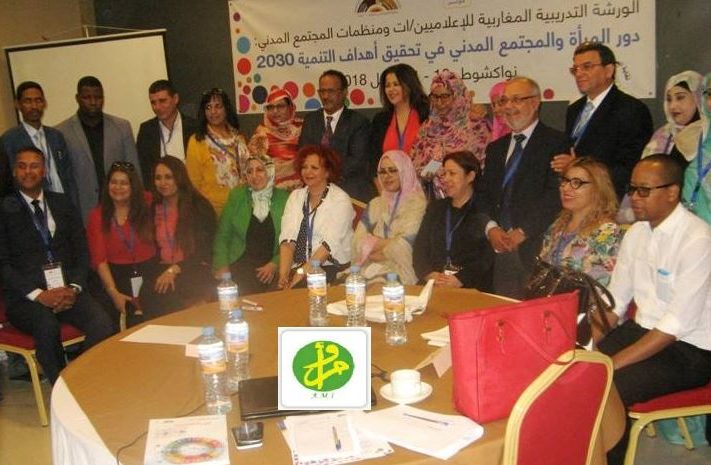
The Arab Forum for Strengthening Media and Civil Society Capacities in Human and Women’s Rights, organised by the Centre of Arab Women for Training and Research (CAWTAR) and the Mauritanian Journalists’ Union with support from the Arab Gulf Programme for Development (AGFUND), concluded on Saturday 14 April with the creation of a Maghreb journalists’ organisation chaired by Mauritania. Named “Maghreb Women Journalists for Sustainable Development”, it comprises Morocco, Algeria, Tunisia and Libya, described as the five Maghreb countries.
The training workshop, divided into several sessions, addressed programmes relating to the “Sustainable Development Agenda and the role of civil society and the media”. Mauritanian Journalists’ Union President Mohamed Salem Ould Dah commended the media’s role in achieving the Sustainable Development Goals and civil society’s contribution to public awareness and social advancement.
Etidal Mejbri, Director of the Centre of Arab Women for Training and Research (CAWTAR), stressed the course’s importance in addressing women’s issues in the sustainable development plan, partnerships between civil society and media, national and regional monitoring of the 2030 Agenda, and narrowing gender gaps as a means of achieving sustainable development in the Arab region. She noted that Tunis-based CAWTAR uses research, training, investigation and meetings in more than 22 Arab countries to establish practices that take the Sustainable Development Goals into account and address globalisation’s challenges.
Tunisian human development expert Ahmed Abdel Nader, who led the workshop’s practical sessions, discussed progress, tasks and roles under the development plan approved by most Arab countries. He said that Morocco was the only Arab country to have presented an action plan for implementing the Sustainable Development Goals by 2030. The plan focuses on six areas, including greater alignment and coherence with national priorities and better coordination, consistency and convergence of public policies to strengthen equality and equal opportunities.
The expert noted that although Arab countries were committed to the 2030 Agenda, which calls for justice, equality, environmental respect and a genuine plan for decent work, social protection and gender equality, numerous problems and obstacles still hindered these goals. Discussing data and reports, particularly the United Nations Programme’s annual Human Development Report for 2016, which examines Arab countries’ development, he said it redefined human development by linking it directly to work and recognising people as the true wealth driving economic development. It placed Maghreb countries at low rankings: Morocco at 123 out of 188 countries, Mauritania at 157 and Algeria at 83, describing them as countries with low human development.
On the use of the term development, Ahmed Abdel Nader said that two years after the adoption of the sustainable development plan for 2030, it was time to review progress and achievement of its seventeen goals, which rest on dignity and equality between people. Fighting poverty, ensuring access for everyone to healthcare, food and quality education, and achieving equality are essential elements of a sustainable, equitable society.